

Max Scherzer, the Piano, and the Power of Play:
What His Recovery Reveals About the Nervous System

To be clear, I don’t know Max Scherzer, or any of the staff he worked with. This is simply a theory—an attempt to make sense of what may have happened beneath the surface. It’s not a claim of fact or a critique of his care, just a different lens to look through. This article references a New York Times article that can be found at the bottom.
Scherzer didn’t fix his thumb.
He changed his nervous system.
For nearly two years, the future Hall of Fame pitcher battled a thumb injury that refused to heal. Shockwave. Laser. Targeted exercises. All the right moves. And still—it didn’t work.
Then he sat down at a piano.
No velocities, pitch counts, joint angles, or biomechanics. Just exploration.
Almost immediately—his thumb started to feel better.
Most people miss the point
The piano likely helped his thumb. Novel dexterity and coordination were probably beneficial to the tissue.
But the bigger story? His nervous system.
Pain—especially persistent pain—is rarely just about tissue. It’s about perception, protection, and prediction.
What trauma can teach sports medicine
We often describe the nervous system in two states: fight/flight or rest/digest.
Stephen Porges, founder of polyvagal theory, offers a more useful lens: the system operates in four states—each shaping how we move, think, and recover:
Movement with fear: running from a threat, tense and reactive
Movement without fear: dancing, playing, exploring freely
Stillness with fear: frozen, stuck, or shut down
Stillness without fear: resting, connecting, feeling safe
A healthy nervous system has access to all four states and isn’t dominated by any one of them. The ability to move fluidly between them is what allows recovery, adaptability, and high performance.
Here’s a simple way to visualize it:
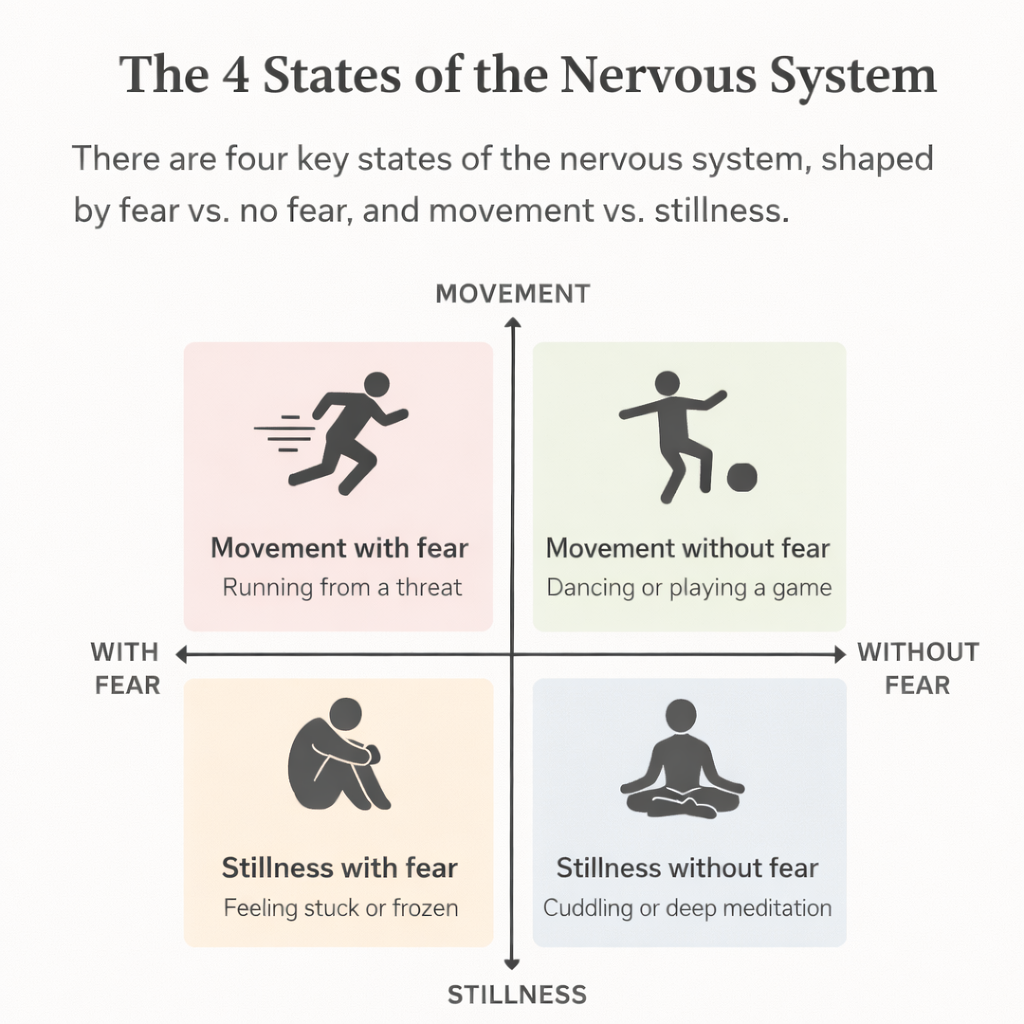
This matters more than most people realize.
Because two people can do the exact same exercise—and get completely different results—based entirely on the state they’re in.
Scherzer’s rehab likely lived in one state. The piano introduced another.
Rehab doesn’t always equal safety
Even the best rehab can live in fear:
“Will this make it worse?”
“Why isn’t it improving?”
“What if this affects my career?”
Movement under fear keeps the system protective: increased tone, guarding, ongoing pain signaling. More reps of… protection.
The real brilliance of the piano might not have been the act, but the state
The piano introduced a completely different category of experience:
No expectation
No evaluation
No consequence
No identity tied to performance
It wasn’t rehab.
It was play.
And that likely shifted him into:
Movement without fear
This can be an incredibly therapeutic state for anyone.
For an athlete known for intensity, it makes sense that real healing came for Mad Max when he allowed himself to soften.
This is a fundamentally different biological environment.
In this state:
The system adapts
Muscles release tension
Coordination improves
Pain decreases
Same body. Different state. Different outcome.
Play vs. work
Rehab is work—especially when progress is slow. It carries pressure, expectation, even grief.
Baseball, something he loved, can start to feel like obligation. Play disappears.
Play signals safety. It allows exploration, creativity, and intrinsic motivation.
Even in dementia care, playful activities tied to earlier life experiences can improve engagement, mood, and cognitive access—not through effort, but by creating a safe state.
What this means for training and performance
Looking only at what someone does misses the point. You have to consider how they do it.
Strength from fear ≠ strength
Stretch from tension ≠ flexibility
Doing everything “right” doesn’t guarantee improvement
The nervous system sets the ceiling.
A better question
Instead of:
“What’s the best exercise?”
Ask:
“What state is this person in while doing it?”
“How do we create conditions for movement without fear?”
The deeper takeaway
Scherzer didn’t grind his way out of injury.
He played his way into a different state.
And from there, his body could finally do what it had been trying to do all along:
Adapt.
References
New York Times / The Athletic. Max Scherzer, Blue Jays, and the piano thumb injury story. Link
Porges, Stephen W. The Polyvagal Theory: Neurophysiological Foundations of Emotions, Attachment, Communication, and Self-Regulation.